Category: Tag

  • Why does every business need to track their inventory?

    Why does every business need to track their inventory?

    Small business owners of today have considerable advantages over those of only a few decades ago. Technological advances make many business aspects more efficient and offer a number of effective tools. From basic information technology to logistics, marketing, and human resources, there are affordable and efficient ways of performing manual functions and tasks that were previously tedious, including ways of Inventory tracking.

    Inventory tasks include:

    • Planning for seasonal activities for companies shipping large quantities of products
    • Anticipating shortages
    • Anticipating growth in demand from promotions and added marketing success
    • Providing the necessary financial reporting information


    An effective inventory approach will:

    • Achieve maximum discounts on the purchase level
    • Improve negotiating a position with vendors and shipping sources
    • Help meet overall customer expectations and needs
    • Control Working capital investment
    • Minimize the cost of ordering too often and the need for rush delivery
    • Minimize shortage and out-of-stock costs
    • Lower capital costs for excess inventory
    • Reduce losses due to outdated inventories


    Radio frequency identification (RFID) is a technology that creates visibility and helps to control the warehouse inventory.

    Omnia produces RFID tags which are small microchips plus a small aerial that may contain a range of digital information about a specific item. RFID Tags are embedded in plastic, paper or similar material and attached to a product or packaging, a pallet or container, or even a van or truck.  An RFID reader interviews the tag, transmitting and receiving radio signals from and to the tag. Using special computer software the information the reader collects is collected and processed. Readers can be placed in a factory or warehouse at different positions to show when goods are being moved.

    RFID technology helps to identify and record individual products and components and track them from production to point-of-sale throughout the verticals. This process does not require direct line-of-sight and creates inventory visibility in hand, thus helping to make proper use of it. With the help of this technology, each inventory/stock movement can be automatically stored on the system.

    The use of RFID tagging for stock control offers several advantages over other methods such as barcodes:

    • tags can be read remotely, often at a distance of several meters
    • several tags can be read at once, enabling an entire pallet-load of products to be checked simultaneously
    • tags can be given unique identification codes so that individual products can be tracked
    • RFID tags can be overwritten, enabling information about items to be updated, eg when they are moved from one part of a factory to another.

    Over the past few years, the costs associated with RFID tagging have fallen and continue to fall. The benefits of more efficient stock control and enhanced security make it particularly attractive to retailers, wholesalers or distributors stocking a wide range of items, and to manufacturers producing volume runs of products for various customers.

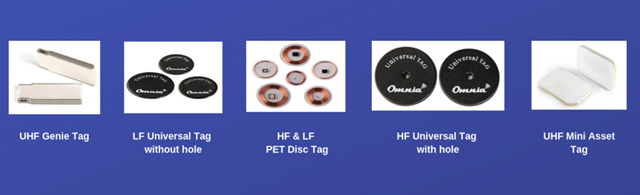
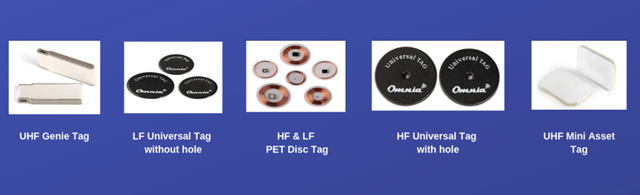
    Suitable Omnia RFID Tags:
    A close-up of several disc discs

AI-generated content may be incorrect.
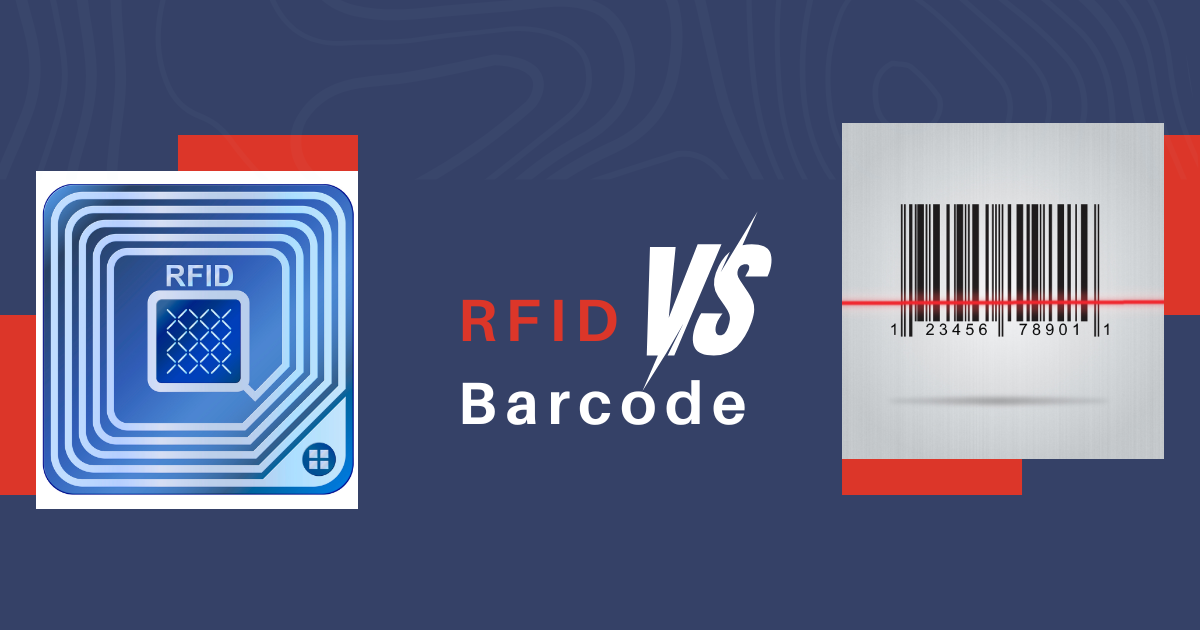
  • RFID V/S Barcode

    RFID V/S Barcode

    Advantages of using RFID Technology over Barcode?

    Radio Frequency Identification (RFID) is a wireless communication technology that can define particular objectives and read and write associated information via radio signals without creating mechanical or optical contact between identification scheme and particular objectives. Radio signals are transmitted from RFID tags attached to objects by electromagnetic fields tuned to radio frequencies to automatically identify and track the objects.

    Barcode technology is the abbreviation of barcode auto-identification technology. It is an automatic technology for the recognition of symbols based on modern IT. It can incorporate symbol coding features, data acquisition, automatic identification, information input, and storage. It can efficiently fix the issues of big amounts of at acquisition and automatic input in the logistics system.

    The advantages of RFID technology over barcode technology:

    1. RFID tags are more secure:

    Because RFID carries electronic information, it’s data content can be protected by encryption technology, so that its content is not easy to be forged and altered, while barcode is exposed to physical information, and the use of common coding rules, data security can not be guaranteed.

    2. Higher efficiency of RFID:

    The recognition frequency of barcode scanning is limited, only one barcode can be scanned at a time, and the RFID reader can identify and read several RFID tags at the same time.

    3. The storage capacity of RFID tag Data:

    The capacity of the one-dimensional barcode is 50 bytes, the maximum capacity of the two-dimensional barcode can store 2 to 3000 characters, and the maximum capacity of RFID is several megabytes. With the development of memory carriers, data capacity is also expanding. In the future, the amount of data needed to be carried by articles will be increasing, and the demand for expanding the capacity of storage media will increase accordingly.

    4. Anti- Pollution ability and durability of RFID tags:

    Traditional barcode carriers are paper, so it is vulnerable to pollution, but RFID has a strong resistance to water, oil, and chemicals. In addition, because the bar code is attached to plastic bags or cartons, it is particularly vulnerable to damage; the RFID label is the data stored in the chip, so it can be free from contamination and prolong service life.

    5. The external forms of RFID tags are various:

    RFID is not limited by size and shape in reading. It does not need to solve the size or printing accuracy of the carrier in order to read accurately. In addition, RFID tags can be used in different products with the development of miniaturization and diversification.

    6. RFID Technology can be re-used:

    Traditional barcode carriers are paper, so it is vulnerable to pollution, but RFID has a strong resistance to water, oil, and chemicals. In addition, because the bar code is attached to plastic bags or cartons, it is particularly vulnerable to damage; the RFID label is the data stored in the chip, so it can be free from contamination and prolong service life.

    7. RFID is more penetrating and accessible:

    In the case of coverage, RFID can penetrate non-metallic or non-transparent materials such as paper, wood, and plastics, and can carry out penetrating communication. The barcode scanner can recognize the barcode only at close range and without object obstruction.

    If you want to know more about RFID Technology and Tags, feel free to contact us.

  • RFID in Waste Management

    RFID in Waste Management

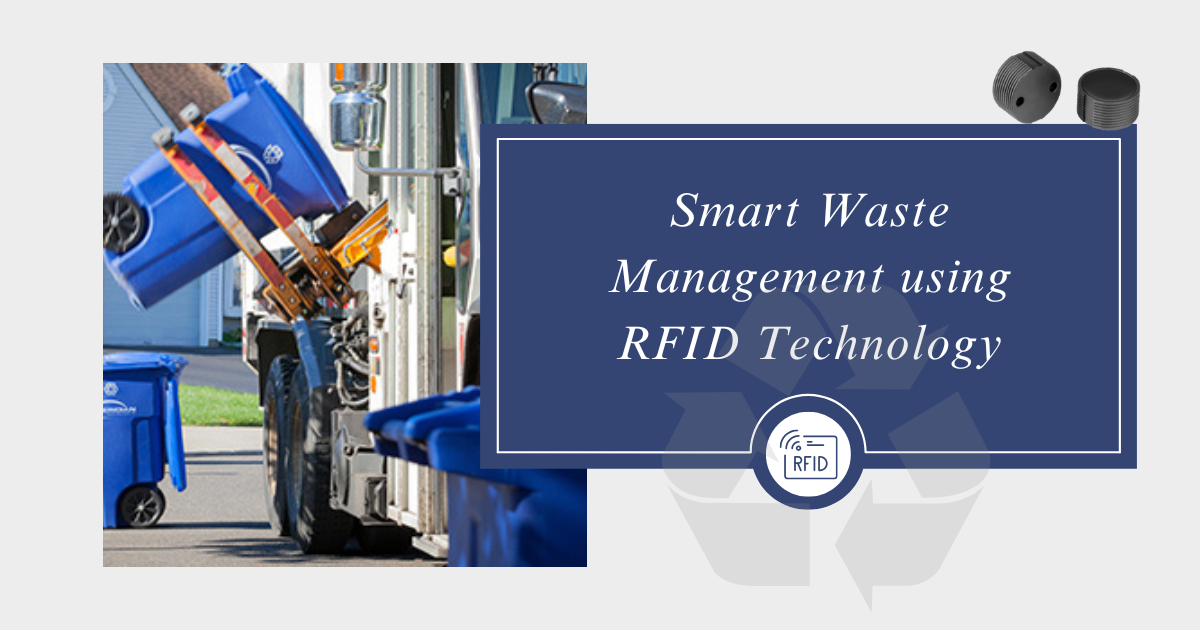
    Smart Waste Management using RFID Technology

    In recent years, waste management services have made a concerted effort to use information technology to reduce waste management costs and to identify missing/stolen bins. The application of these principles can be facilitated by the use of mobile technology such as Radio Frequency Identification (RFID).

    RFID is a modern and fast-growing technology that uniquely and accurately identifies an RFID tag (waste tag) attached to, or embedded in, a waste bin which helps in the identification and traceability of waste bins.

    By using RFID tags, waste can be identified and tracked through the entire waste chain. Many jurisdictions and private sector operations have attached RFID tags to waste containers and equipped their trucks with RFID readers thereby improving sortation, validating and verifying pickups, tracking the number of times a container is used for collection as well as tracking the weight of the container’s contents at each and every pickup. A waste management system using RFID simplifies billing for service.

    RFID is now being used by municipalities and private operators to monitor waste pickup. Waste disposal trucks equipped with RFID readers pick up bins that are equipped with RFID tags. The readers record the exact time and location every time a waste container is emptied. This introduces a new degree of monitoring and control of the waste disposal process. With an RFID based system operators have accurate and real-time data that can be used for customer billing as well as route and resource planning. The real-time aspect allows municipalities to monitor the performance of contractors.

    Waste containers come in many forms, materials, and sizes, but they are all subject to harsh environments and rough handling. Being outdoors, waste containers face all the elements: cold, wet and heat and being waste containers, endure both human and machine abuse. Only RFID tags can withstand these conditions and continue functioning throughout the life cycle of these containers.

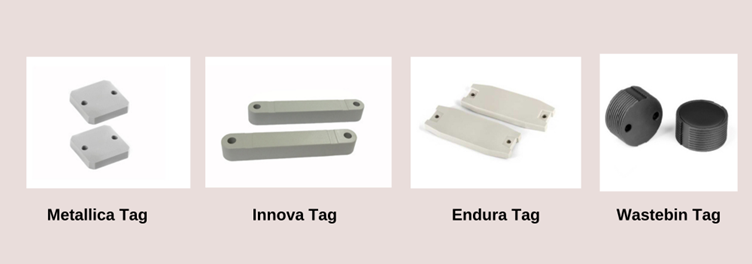
    Omnia Technologies produces Wastebin tags which are manufactured in such a manner that they can withstand any harsh conditions like extreme cold, heat, rains, etc. Also, these tags can be customized according to the requirement of the customer.

    Several pieces of plastic

AI-generated content may be incorrect.

    Benefits of using RFID in Waste Management:

    1. Easier recovery of lost or stolen carts.

    2. Easy accounting of travel routes of garbage trucks and automatic recording for each individual cart pickup with no required driver interaction on the pick-up route.

    3. Cheaper, faster, more accurate data reporting. No manual data entry is required.

    4. Easier waste sorting at the household level.

    5. An unprecedented degree of control and traceability in disposing of hazardous or otherwise sensitive waste material.

    6. Fewer collection points and containers required for recycling.

    7. Less cleaning and maintenance work on recycling

  • All about FASTag

    All about FASTag

    A FASTag is a rechargeable tag that is used to automatically deduct toll charges that allow a vehicle to pass through a toll gate without stopping for payment. It uses radio frequency identification (RFID) technology to make payments without cash through a prepaid account connected to it.

    FASTags are fixed to the windscreen of a vehicle and an RFID antenna in the canopy of the toll gate scans the QR code and the tag identification number, following which the boom barrier lifts to allow a vehicle to pass through. The FASTag comes in seven different colors — violet, orange, yellow, pink, blue, green, and black. Each category of vehicle is assigned with a particular color.

    Benefits of FASTag

    For Vehicle Owners:

    • Hassle-free toll payments at FASTag toll plazas
    • No long queues
    • Non-stop movement of vehicles can lead to lower fuel costs
    • Various payment options like credit/debit cards, NEFT, etc. can be used for online FASTag recharge
    • Up to 0.5%* cashback
    • FASTags can be linked to insurance policies helping customers to do away with the urgency of carrying the policy documents

    For Government:

    • Better highway management
    • Brings on transparency in toll transactions
    • Reduction in revenue leakages
    • Greater project accountability

    For Toll Operators:

    • Cashless payments without the involvement of change
    • Reduced time is taken to process tolls
    • No customer aggression due to long queues and change
    • Reduced operational costs
    • Better audit control through centralised user accounts

    FASTags colours and Vehicles

    A close-up of a card

AI-generated content may be incorrect.

    a) Class 4 vehicle (Car , Jeep , Van) – VIOLET

    b) Class 5 vehicle (Light commercial vehicle, Minibus)- ORANGE


    c) Class 6 vehicle (Bus and Truck 3 axle)- YELLOW


    d) Class 7 vehicle (Bus and Truck 2 axle)- GREEN


    e) Class 12 vehicle (Bus and Truck 4/5/6 axle)- PINK


    f) Class 15 vehicle (Truck 7 or more axle)- BLUE


    g) Class 16 vehicle (Heavy construction machinery and earth moving equipment)- BLACK

    Conclusion

    Getting stuck in long queues while crossing NHAI tolls is perhaps something we have all experienced at some point. National Highways Authority of India or NHAI plans to make this a thing of the past by launching NHAI FASTag program. This implementation by the Indian government has been applauded by all, which is evident from the fact that automatic collections at toll plazas along national highways, in conjunction with toll plaza free passes, has led to 24% increase in electronic toll revenue. Indian transportation as we know is the backbone of Indian economy, and with this move, this backbone will only strengthen.

    Get in Touch

    For any questions regarding FASTag, reach us at sales@omniatags.com