Category: RFID

  • RFID for Animal Tracking and Identification

    RFID for Animal Tracking and Identification

    Ranchers, farmers, and other livestock professionals use RFID technology to track and record a variety of everyday data, such as how much a cow is being fed each day and how many male and female animals are on a ranch at a given time.

    In addition to monitoring general animal locations, RFID tags can gather other valuable data to evaluate long-term patterns, such as genetic disorders, health problems, and even possible social threats in a given herd or flock. RFID tags attached to an individual animal can hold basic data, like its birth date, breeding details, and what inoculations it has received. Since tags can detect if an animal is unwell, livestock owners can address any health problems before they get out of control. Sensors can also relay valuable data about the animal’s eating habits and weight. When comparing the collected data of a group of cows, you can determine which animal in the group eats first and which cows prefer to eat with other cows. Details about the social habits of cows can also be captured thanks to RFID tags.

    Our Products

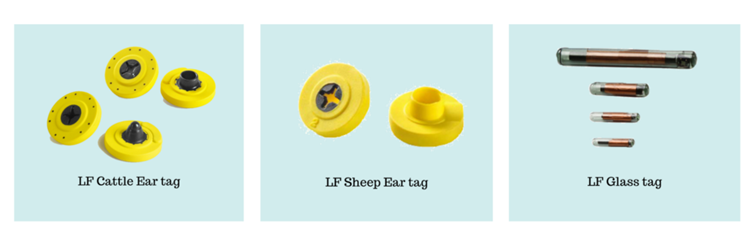
    Cattle and Sheep Ear Tags :

    These tags are ideal for the identification, tracking, and health, history & nutrition management of cattle and sheep respectively. They are made with special TPU material and are over-molded making them more robust and durable in the outdoor environment.

    They can be reusable or tamper-proof depending on the application. They are available with different chips and memory sizes including FDX and HDX animal modes and can be made in custom colors.

    Glass Tag :

    RFID Glass Tags are ideal for animal Identification as well as medical testing applications. They are also suitable for automotive applications such as immobilizer. These tags are available in various sizes with different chips & memory sizes. All glass tags undergo a 100% test regarding optical, mechanical, and electrical parameters prior to delivery thus guaranteeing the highest quality standards.

    Watch the video to know more about these tags and their benefits.

    Get in touch with us:

    sales@omniatags.com

  • Redefining your Laundry Management using RFID

    Redefining your Laundry Management using RFID

    It is getting popular to apply RFID Technology in the laundry process for automated garment identification and sorting. Healthcare organizations are tagging linens and gowns to monitor usage and inventories and automate distribution. RFID reduces shrinkage and the need for staff. Industrial laundries and commercial cleaners are also using RFID technology to improve inventory control, reduce labor cost and optimize the life-cycle management of individual textiles and garments. Real-time traceability delivers more accurate and timely billing and enhances customer satisfaction. 

    Omnia Technologies is specialized in the RFID technology development. With the know-how in laundry business process, Omnia provides superior RFID Laundry Tags. The laundry management system automatically tracks and manages laundry activity for customer-owned and rental uniforms and linens. The RFID technology works by electronically reading RFID tags attached to the uniforms and linens, allowing them to be automatically identified, counted and tracked. The system also facilitates sorting and validates pick-ups and deliveries at customer locations.

    A diagram of a laundry washing process

AI-generated content may be incorrect.

    Benefits of using RFID in Laundry Management

    This simple and transparent RFID based process, allows customers to be in complete control of their linen stock and can even inform the laundry when a new delivery is required. This can be done by simply scanning clean stock stored in linen rooms by their own staff to create an inventory that is uploaded to the cloud One of the main advantages for the customer is that they don’t have to manually count and sort the laundry which significantly reduces labour costs and increases accuracy.

    • Real-time tracking of the laundry items from point of pick-up, through sorting, washing or dry-cleaning, packaging, and distribution.
    • Reduced handling time at check in and check out on site and off site.
    • Automatic identification of misplaced and stolen items.
    • Accurate data capture regarding item life-cycle, inventory control, reusable asset sterilization control as well as automatic billing to end users.

    Quality control can also reach higher levels of accuracy because the laundry is able to analyse and monitor the journey of individual items. This means it can identify when an item is reaching the end of its lifespan, so it can be replaced immediately. This results in fewer items being rejected manually during the laundry process and provides hotels with a further increased level of service efficiency.

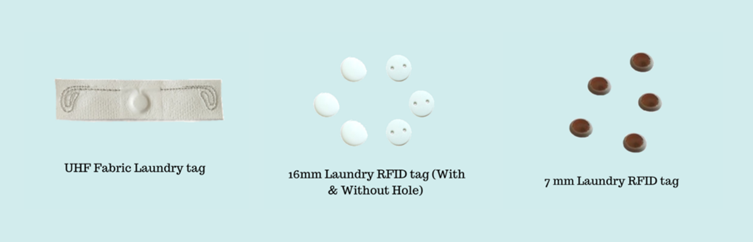
    Our Laundry Tags

    A circular white object with black text

AI-generated content may be incorrect.
  • RFID: Automated Tire Identification

    RFID: Automated Tire Identification

    As the tire industry continues to move towards full automation and Industry 4.0, the conversations surrounding RFID become more and more relevant. From easier tracking through manufacturing to waste reduction efforts, to improved automotive safety and visibility of lifetime performance, the benefits realized from RFID are virtually endless.

     RFID consists of a tiny radio transmitter (high technology transponder) and the chip that is placed inside a tire or on the outside sidewall. This transponder/chip assembly can be interrogated by a scanner that contacts it using the correct frequency and protocol. But RFID is much, much more. There are so many applications for this technology that it is staggering.

    Tracking is the key

    RFIDs offer an exclusive number that recognizes the tire as well as allows the tire manufacturers to track that using the manufacturing procedure, inventories, and shipping to the end-user and final point-of-sale. RFIDs can be used for tracking every tire’s history and the data can be saved in the tire manufacturer’s hosted Cloud in the maintenance management program.

    RFIDs can be used for tracking the tires from picking up at the location using the retread procedure and delivery back towards the fleet. The manufacturer’s software contains data about the number of times a tire got retreaded, repairing it has got, its temperature and pressure history, tread depths, mileage, and the sources of failure in order that fleets can determine when the tire’s lifespan will end and when it should get replaced.

    On the macro level, the data can be analyzed in a database for determining the finest tires as well as retreads for running in the operations and also take other well-versed decisions about age limits, retreading the number of times, and detecting problems with any particular tire and see if any improvements are required in the tire maintenance.

    Our Tire Tags

    • A truck with a remote control

AI-generated content may be incorrect.

    UHF Spring Tire Tag has very high performance. It is embedded into the tire so that we can track the tire electronically. Widely used in the tire factory, such as tires storing, servicing, anti-stealing, and recollecting, for inventory management. They are easy to install. It survives the high temperatures encountered in the tire curing process and is robust enough to remain operational throughout the operating life of the tire. The microchip stores the tire’s unique ID, which can be associated with the vehicle identification number. The chip can also store information about when and where the tire was made, its maximum inflation pressure, size, and so on. Information can be updated with a handheld reader.

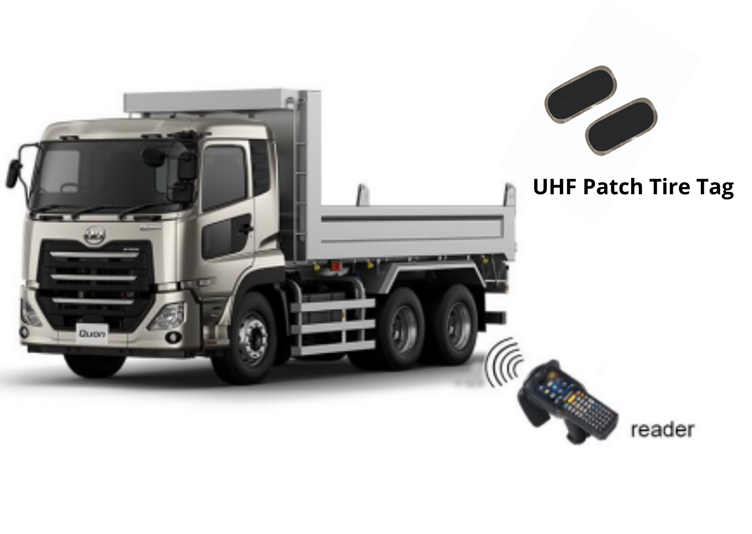
    UHF Tire Patch tag is specially designed for tire tracking and management application after the tires are manufactured. These tags are designed to meet all requirements in terms of pressure, heat, and chemical resistance in the application of contactless tracking of the tire. This tag developed to track finished tires, with a unique identification number to prevent tire theft and cloning, It will last the lifetime of the tire. It should be attached inside the sidewall of the tire with a vulcanizing agent, mainly used for bus tires, truck tires, trailer tires, etc.

    Benefits

    # Track and log vehicle entry/exit.

    # Track vehicle movement across locations.

    # Locate vehicle current location

    # Optimize vehicle usage

    # Can be integrated with access control barriers (Vehicles can be checked out automatically, along with an identified load. They can be checked back in again just as easily.)

    # Identify a vehicle and access information about it by reading its RFID tag is a benefit for companies like car rental agencies, car dealerships, and car wash facilities. With the addition of software, these companies can pull up car records or purchases by just reading the car’s unique RFID tag.

    # Controlled Costs: as warehouses can be easily tracked with minimal labor or resources

    # Improved Inventory Tracking: as entire pallets can be easily scanned and accounted for without direct line of sight.

  • What role does passive RFID technology play in enabling the internet of things?

    What role does passive RFID technology play in enabling the internet of things?

    The Internet of Things (IoT) has taken over the technology world, and it shows no signs of slowing down anytime soon. The Internet of Things has the potential to transform supply chain visibility as we know it, ushering in a new era of data intelligence and accessibility.

    Simply put, the Internet of Things (IoT) is a network of devices that allows data about each device to be accessed, collected, and exchanged, allowing complete, real-time visibility and control of any item that is connected to the Internet.

    A well-designed and properly deployed passive RFID system can make almost any type of “thing” (asset) visible to the Internet.

    There are literally thousands of different types of RFID tags on the market today. RFID tags have progressed over the last ten years. Sensitivity has risen in tandem with reading ranges. There are tags designed specifically for metal, liquid, paint, and almost any other material you can think of. They are available in a variety of memory capacities and configurations, allowing each tag to be uniquely identified. Suffice it to say, there is an RFID tag for almost every type of “thing” in our world today.

    RFID tags communicate with RFID readers using the radio frequency waves transmitted to them. And although you cannot practically assign an IP address to an RFID tag, the tags are encoded (programmed) with an ID that uniquely identifies it to a particular business or organization. With this understanding, you can begin to understand how placing passive RFID tags on inanimate objects, or “things,” allows these assets to become visible to the Internet, further enabling the vision of the “Internet of Things.”

    The RFID middleware is a critical component of a passive RFID system. This critical software component is responsible for configuring and controlling RFID readers. It receives and processes RFID tag data from readers and sends RFID tag events to business systems like ERP, and/or WMS. 

    Now that things are visible to the Internet using RFID, we can use the technology to report what those assets are doing. This means that we can use RFID to report the movement of things through a business process. The RFID middleware has powerful filtering algorithms that allow us to configure the RFID system to only report RFID tag data when important business events occur.

    A shipping application is an example of this; as a shipment is staged to be loaded on a truck, the RFID system captures each item as it is staged at the shipping dock. Once the shipment has been staged, it can be checked against a bill of lading to ensure that it is complete. As the items are loaded onto the truck, the RFID system will detect them and report them as “On Truck” by observing them move through a dock door portal. Another example would be tracking high-value assets like tools. An RFID system can see the location of an important tool and report on its movement from location to location.

    Conclusion

    You can now see how passive RFID technology helps to enable the Internet of Things. Overall, important assets can be tracked and utilized more effectively. It is safe to say that incorporating RFID technology into the Internet of Things can and will enable businesses to achieve operational and financial levels of performance never before seen.

  • Which RFID Tag is best suited for my application?

    Which RFID Tag is best suited for my application?

    Selecting the best RFID Tag

    I prefer to think of the decision-making process for the proper RFID tag as a large funnel with all of the possible RFID tags at the top, and with each question you ask yourself, you remove more tags from the funnel until only the right tag for your application remains.

    What RFID Technology Is Best For Me – Active Or Passive?

    After you have selected RFID as your technology of choice one of the first questions you may ask is whether or not you should use an active RFID tag or a passive RFID tag in your application. The answer to that question, and many others when it comes to RFID-related questions, is “it depends.

    Let’s look at both options. First, let’s examine passive tags. Passive tags do not have their own power source. First, they are less expensive than their active counterpart. Second, because they do not have a battery, they will last longer than an active RFID tag. Third, again because passive tags do not have a battery, they tend to be smaller and more lightweight than active RFID tags.

    Active tags have an onboard power source used for transmitting, usually a battery. The tag uses the battery to power its integrated circuit (IC). They have more memory which means they can store more data. Second, due to their battery-powered ICs, they have longer read ranges than their passive counterparts. However, as I alluded to above, active tags are more expensive, have a shorter lifespan, and are bulkier than passive RFID tags.

    For the purpose of this article, I am going to assume a passive tag will work best in your application.

    Choosing the right Frequency

    Next, in order to select the best tag for your application, it is critical to understand the various frequencies available with passive tags. RFID frequencies are classified as low frequency (LF), high frequency (HF), and ultra-high frequency (UHF).

    The answer to which frequency to use is the same as the response to whether to use active or passive RFID: “it depends.” It depends on the nature of the application and the product being tracked in this scenario. Low-frequency RFID tags (125 – 134 kHz) are commonly employed for access control and animal tracking applications, for example. They have a restricted read range, but because of their long wavelength, radio waves can penetrate metallic surfaces more easily than other frequencies.

    Next, high-frequency RFID tags (13.56 MHz) are appropriate for situations where an item’s closeness to another item, such as library books, may be an issue. Another potential application is access control, which is used to track the flow of patients in hospitals, medical clinics, and other healthcare settings. NFC, or near-field communication, is a type of high-frequency communication that includes an NDEF statement that permits information to be transmitted between two devices, allowing for contactless payments. These tags have substantially shorter read ranges than their UHF counterparts.

    Finally, we must consider UHF, or ultra-high frequency, RFID tags. UHF tags (860-960 MHz) are generally found in more open settings, such as warehouses and manufacturing plants, where speed and efficiency are essential elements. Because of their longer read ranges, they are also extensively employed in electronic toll collection and parking access control.

    Again, for the purposes of this post, I will assume that a passive UHF tag is the best option for your unique application.

    On what surface is the tag being applied?

    We need to look more closely at the environmental variables that surround the RFID tag. For example, what type of surface will the RFID tag be placed to? Is it made of plastic, metal, glass, wood, or another material? Optimized performance is ensured by matching the proper inlay to the application surface.

    In order to get an RFID tag to read on metal, you must use an on-metal RFID tag, in other words, an inlay specially designed to work on metal. Foam is the most commonly used standoff for many on-metal RFID tags. Glass is another surface for which users often optimize tag performance. In fact, there are some tags that perform better on glass than they do on plastics.

    Durability

    How long do you want the RFID tag to be functional? Will the RFID tag be exposed to chemicals, and if so, what type and how long will it be exposed? These types of inquiries will assist in determining what type of RFID tag construction is required to accomplish the intended output for your application while also ensuring the RFID tag survives the environmental conditions it will be subjected to. For example, if an application requires a tag to be exposed to the elements for five years, you should select materials that can withstand such circumstances, such as polyester, rather than paper, in the tag’s fabrication.

    Ready to choose your RFID Tag?